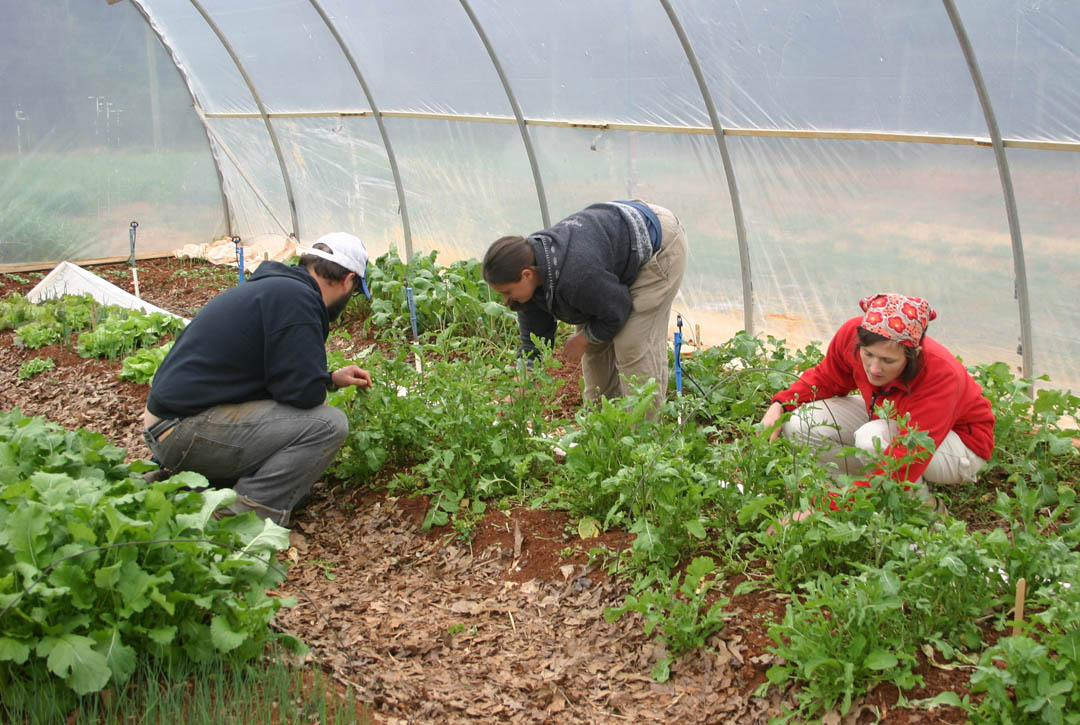
Kamis, 17 November 2011

Voluntary Creative Simplicity


How we went from $42,000 to $6,500 and lived to tell about it!
By L. Kevin & Donna Philippe-Johnson

As a middle class American, it's been difficult for me to understand how we are
supposed to make a living when there are so many things working against us. How
can we go on day after day with the rising cost of food, fuel, utilities, car
insurance, taxes and health care, while dealing with the insecurity of
unemployment?

In the past, whenever I considered these things, I felt a hopeless
sense of impending doom in the pit of my stomach. There is so much talk about
how to solve these issues, but nothing ever seems to stop the downward spiral of
struggle and stress that millions of folks are experiencing.

Like many working people, my life went along fine during the 1980s. I had a good
paying job ($42,000 a year) and though I didn't enjoy the kind of work I was
doing as an industrial draftsman, receiving a steady paycheck every week kept me
going without much complaint.

But then came the Gulf War in the 1990s and after
that point I faced nine layoffs over the span of 10 years. By the time September
11 happened, I hadn't been able to maintain steady employment in the
petrochemical industry for over a decade. I would work about three or four
months, then back again to the unemployment line.

It was at this point that I realized that something was wrong. The life strategy
I had grown up to believe in was no longer working and there didn't seem to be
any answers. Obviously no one was going to get me out of this, so I decided I
needed to take matters into my own hands and figure out a way to redefine my
basic approach to living.

Lucky for me, I have an adventurous wife. She was on the same page with me and
was willing to make some drastic changes in our lifestyle. As a committed team,
we decided to figure out another way to survive despite these uncertain, hard
economic times. Since we didn't have a lot of money and because it was getting
harder to find steady employment, we decided to rethink our basic values in
order to create a life for ourselves where we could be independent and free of
needing a career or a full-time job.

And for us, that meant first and foremost, moving to the country. If we were
going to be poor, we thought, at least it would be better to be poor in the
country. That way we could grow our own food and reduce our expenses. Eventually
we discovered that there were others who felt the same way we did. Today there
is a small, but growing movement in this country towards a lifestyle we call
"Voluntary Creative Simplicity."

We decided to start over, to shake loose from all the things holding us down. We
got rid of all the stuff we didn't need and worked on paying off debt. Then
canceling our credit cards and using cash, we followed an efficient financial
plan that taught how to track every penny. By doing this we were able eventually
to save a little bit of money. (See the book entitled, Your Money or Your Life,
by Joe Dominguez & Vicki Robin.)

Also, we wanted to be strong and healthy to do the work required for this basic
lifestyle so we changed our eating habits. We broke away from the standard
American fast food, pre-packaged supermarket diet in favor of organically grown
whole grains, raw fruits and vegetables, fermented dairy, nuts, seeds and
sprouts and eliminated all junk foods and prescription drugs. We started
exercising regularly by walking, practicing yoga, and gardening.

Since we no longer wanted to pay health insurance premiums, we decided to start a special
savings account ($1,000) just for emergency first-aid treatment. And of course
we got rid of the cell phone, cable television and Internet bills and greatly
minimized our use of air conditioning. The beginning of the path to the simple
life was a process of elimination in every aspect of our lives.

Eventually we found 2-1/2 acres of land, 35 miles out of the city. Inspired by
our new vision, one summer we said goodbye to the city, permanently moved out to
our new place and set up a dome tent to live in. We happily lived in our tent
that summer while clearing the land and constructing a rustic 10' by 12' room
with a sleeping loft. We did this on a "pay-as-you-go" plan, hauling all the
materials in the back of our old pickup truck. Never having built anything
before, we worked hard and gained the skill of building our own shelter.

As the tiny outbuilding took shape, next came the installation of an underground
cistern for collecting rainwater, and finally, the construction of our
three-room (500 square foot) cabin. Since we had to borrow $9,000 to purchase
the property, I continued to take whatever jobs I could find (drafting, clerk
work, courier, dishwasher, bakery assistant, etc.) while Donna stayed busy
working on our organic garden, planting fruit trees and composting. She enjoys
learning about native plants and healing herbs that she can grow.

Over the next few years, while working toward our goals of self-reliance and
independence, we became stronger, healthier and more confident in our ability to
rely on our own skills. It was quite an empowering experience. We learned how to
build things, grow our own food, take responsibility for our own health, and
best of all, we learned how to laugh and have fun again.

The simple joys and true pleasures of fresh, home-grown food, watching everything grow and prosper
in harmony, working with our own hands and spending quality time together
replaced all of the costly false values that had occupied our time before.

Gradually we paid off the land, finished the cabin and succeeded in minimizing
our basic utility costs. We began to notice that our expenses were decreasing as
the quality of our life was increasing. As long as we stayed home and didn't
travel to a steady job we really didn't need very much money. The lifestyle of
voluntary creative simplicity was resulting in compounding efficiency and
improvement in every area of our lives. Soon, we saw the proof of the
inefficiency of working a full-time job.

After figuring in the work-related expenses of one job, I realized that my take home pay was only $3 an hour! Atthat point I was convinced that it was far more cost effective to stay home,
grow our own food, split our own firewood and bake our own bread than it was to
travel to a job day after day. Yet we still needed some form of income.

Though we had reduced the amount we needed to around $540 a month (way below the
poverty level in America), we still had to find a way to generate that income
without relying on full-time employment. Once we had succeeded in drastically
reducing the amount of money we needed, I knew it would be easy to earn this
income by working odd jobs such as building rustic furniture, playing guitar for
tips, simple carpentry, part-time drafting, office work, plumbing, etc. However,
there was one thing I really loved to do...bake handmade whole-grain sourdough
bread in an outdoor wood-fired clay oven! I had always shared my bread with
friends and family, but it never really occurred to me to do it as a way to earn
extra money.

We soon discovered that there was no authentic, handmade sourdough bread being
produced in our area, and little by little, people began asking if they could
trade or buy from us. Within a year we had enough bread customers to generate
the supplemental income needed to meet our modest expenses. And now there is
even more demand and a waiting list of neighbors and friends who want our bread
regularly.

They know our bread is special because the organic wheat is freshly
hand milled, the loaves are lovingly made entirely by hand and baked in our
outdoor clay oven. (See our article, "A Homemade Clay Oven and Naturally
Fermented Sourdough Bread," in the July/August 2005 issue of COUNTRYSIDE.)

We want to let others know there is a wide open market for this kind of
specialty bread, even in very small towns like ours, because so many people, for
various reasons, are unable or unwilling to make it for themselves. In fact,
there is such a demand for this unique artisan bread that many people are
perfectly willing to pay us $4.50 a loaf! Anyone who wants to earn a little
extra cash, say $50-$100 a week or more, should consider learning this valuable
skill, then educating and sharing in their local community.

We continuously hand out educational material about the health benefits of sourdough bread, offer
informative presentations in our local community and give out free bread
samples.

Our system of distribution is arranged like a "bread co-op." There are regular
customers who buy a batch of six loaves at a time, which we deliver fresh to
them once a month. An added bonus of learning this skill is the inexpensive,
incredibly delicious, wholesome bread that we make for ourselves, which helps
reduce our food bill. This is just an example of how a valuable skill such as
this can be financially supportive when you are living and thinking small.

While the key to the lifestyle of voluntary simplicity, is "thinking small,"
many people still believe the opposite is true-"bigger is better." For example,
people often tell us we should invest in a commercial bakery and produce more
sourdough bread. But in order to expand and make a career out of baking and
selling bread, we would have to go into debt to purchase commercial mixers,
freezers and large ovens, work longer hours and face the mountain of
bureaucratic permits, codes, fees and restrictions. As a result, the simple,
authentic handmade artisan bread that our customers love would have to be
sacrificed in favor of expanding volume and making more money.

Everybody loses but the bankers and the bureaucrats. We would fall right back in the same old
trap, getting into debt and sacrificing our freedom and quality of life for a
job. This is an example of compounding inefficiency.

The downfall of many people who would like to break the bonds of stress and
financial enslavement to the system is their tendency to think too big. But we
must realize that this has been programmed into us by the industrial society and
loan institutions, all attempting to excite and feed our insatiable desires.

Friends, it takes a lot of mindful awareness to break free of all these traps.
It also requires an ability to improvise and adapt towards an alternative model.
The lifestyle of voluntary simplicity is one option and the resulting benefits
are transformational.

The point I'm making is this: many of us can no longer think in terms of having
a lifetime career anymore. For whatever reason, things are changing in this
country. Outsourcing and cheaper labor costs in other countries will continue to
eliminate jobs in the United States. And though the opportunity still exists to
work, we must understand that it may be only temporary. While continuing to work
at a job or career one should be wise and set up a plan to survive without
steady employment for certain periods of time if necessary.

This could mean storing some supplies, purchasing a piece of property where a
small shelter, tent or tipi can be erected if necessary, or getting out of the
city and into the country where one can provide food for themselves. My old
Grandpa used to say, "all the troubles in this country began when people stopped
growing their own food." And he was right. The younglings of this modern age
don't even know what real food is, much less how to grow or prepare it! This has
to change. (That's another reason we promote sourdough bread baking. It is time
to start a "slow-food" movement).

Thinking small is one of the most intelligent and powerful things one can do.
Consciously reducing one's life down to the simple basics is the secret to
happiness. And it is so easy. What is the solution? This is our advice,
especially to young people:

"Don't get in debt, don't think in terms of a career (work at a job for one
reason only, to get paid so you can buy a place to live and grow some food),
live in a small shelter, unload unnecessary stuff, reduce monthly expenses,
extract yourself from the enslavement of modern technological materialism, stay
healthy by exercising, eat a simple, wholesome diet, develop some practical
skills, practice your art or trade and serve your local community. Teach your
children to value true pleasures. Real wealth is perishable: food, health,
trees, flowers, herbs, healthy soil, clean water, fresh air, friends and art.
Learn to value and appreciate these above all else."

Of course we realize that everyone has to creatively work out their own unique
plan according to their particular circumstances, especially if there are
children to raise. (We have six grown children.) But with "small thinking," so
many opportunities open up and the more one can release, the more freedom there
is to experience with each passing year.

If someone would have suggested to us ten years ago that there was a way for the
two of us to live on much less, build our own little hut, buy our freedom, give
up steady employment, work fewer hours, become happy, healthy, debt free,
self-reliant, and live fearlessly without health insurance, I would have told
them they were crazy.

This has been an incredible, radical journey for us, but now we know from first hand experience that with vision, patience, self-discipline and courage, it is possible to create such a reality.

Creative voluntary simplicity expands faster than inflation. For those who can
do it, instead of thinking too big and chasing after more money to find
happiness and security, the answer can truly be summed up in the words of the
Greek philosopher, Diogenes: "True freedom is in the minimum of needs."
Kevin and Donna have an instructional video (VHS format only) on baking
naturally fermented sourdough bread for $30. This includes the video, a set of
written instructions, a packet of starter culture and shipping costs. Send check

or money order to L. Kevin Johnson, 4402 Gilead Rd., Clinton, LA 70722.

Minggu, 13 November 2011

Taming Unruly Wind Power


For decades, electric companies have swung into emergency mode when demand soars on blistering hot days, appealing to households to use less power. But with the rise of wind energy, utilities in the Pacific Northwest are sometimes dealing with the opposite: moments when there is too much electricity for the grid to soak up.

So in a novel pilot project, they have recruited consumers to draw in excess electricity when that happens, storing it in a basement water heater or a space heater outfitted by the utility. The effort is rooted in some brushes with danger.

In June 2010, for example, a violent storm in the Northwest caused a simultaneous surge in wind power and in traditional hydropower, creating an oversupply that threatened to overwhelm the grid and cause a blackout.

As a result, the Bonneville Power Administration, the wholesale supplier to a broad swath of the region, turned this year to a strategy common to regions with hot summers: adjusting volunteers’ home appliances by remote control to balance supply and demand.

When excess supply threatens Bonneville’s grid, an operator in a control room hundreds of miles away will now dial up a volunteer’s water heater, raising the thermostat by 60 more degrees. Ceramic bricks in a nearby electric space heater can be warmed to hundreds of degrees.The devices then function as thermal batteries, capable of giving back the energy when it is needed.

Microchips run both systems, ensuring that tap-water and room temperatures in the home hardly vary.
“It’s a little bit of that Big Brother control, almost,” said Theresa Rothweiler, a teacher’s aide in the Port Angeles, Wash., school system who nonetheless signed up for the program with her husband, Bruce, a teacher.

She said she had been intrigued by an ad that Bonneville placed in the local paper that asked consumers to help enable the grid to absorb more renewable energy, especially wind.

“We’re always looking at ways to save energy, or be more efficient or green, however you want to put it,” said Ms. Rothweiler, who worries about leaving the planet a livable place for her 21-year-old daughter, Gretchen. Bonneville paid for the special technology, which runs around $1,000 per home.

The initial goal of Bonneville’s pilot program is to gain experience in charging and “discharging” the water heaters and space heaters to see how much response operators can count on as the use of these thermal batteries expands.

Mark K. Lauby, director of reliability assessment at the North American Electric Reliability Corporation, which enforces standards on the grid, said that such storage innovations would be “the holy grail” as the nation shifts to greater reliance on renewable energy.        

Jumat, 11 November 2011

New Vrindaban Organic Gardening Inspires Local Sustainability


 By Madhava Smullen for ISKCON News on 5 Nov 2011
Tapahpunja Dasa teaches students at the Small Farm Training Center garden in New Vrindaban
A New Vrindaban devotee’s efforts at organic gardening have inspired the general public, educational institutions, and leaders in the local town of Wheeling, West Virginia to support sustainability, eat local produce and consider spiritual motives for it.
Raised on a farm in Northern Michigan, Tapahpunja Dasa was attracted to ISKCON’s “simple-living, high-thinking” message and joined in 1974 in New Vrindaban, where he began growing organic produce. After some side projects over the years, such as missionary work overseas and starting North America’s first Food For Life program in 1982, he restarted his organic growing in 1996, and has been “focused on creating a connection between spirituality and sustainability” for the past thirteen years.
“I believe that if we want the rural, Krishna conscious lifestyle that Srila Prabhupada desired for New Vrindaban—not just generic cow protection or hobby gardening—it must be a centrally located, highly visible part of our outreach,” he says. “When I presented these thoughts to the New Vrindaban management, they kindly granted me a piece of property right in the center of the community, directly across from the temple, to turn my ambition into reality.”
To make the project more accessible to the general public and to secular organizations, Tapahpunja created his own 501 C3 charity organization called The
Small Farm Training Center, which names New Vrindaban as its “host community.”
Tourists visit New Vrindaban's garden's regularly
Over the past six years, he has developed a vibrant apprentice farming program, which draws between eight and fourteen college students every season (from March till November), enthusiastic about getting their hands dirty and learning sustainability. They go through three levels of training: backyard gardening, market gardening—learning how to trade, barter and sell one’s produce at a farmer’s market—and mini-farming, which is performed on a six-and-a-half acre site called The Garden of Seven Gates.
“Rather than just grunt work, I want to give them a rich, well-rounded experience,” Tapahpunja says. “I’d like them to leave with a very solid foundation of why we should be sustainable, so that they can be articulate spokespersons on the issue.”
In return for their work, the students receive room and board, staying at the project’s Small Farm Guesthouse and eating prasadam. Many comment that they feel comfortable and cared for.
There is no pressure to go any further than learning the ABCs of organic gardening, but Tapahpunja does explain to the students that his Training Center’s host is a spiritual community with a beautiful temple, delicious vegetarian meals, philosophical classes, and the renowned tourist attraction Prabhupada’s Palace of Gold, which they are welcome to check out.
Harvesting Potatoes
Those who are more spiritually-inclined do, and, like Tapahpunja in the 1970s, they are astounded at the rich culture and philosophy integrated with the natural lifestyle.
“We have a lot to offer to the worldwide dialogue on sustainability,” Tapahpunja says. “At the heart of it all is the fact that there is really no such thing as sustainability in this world—everything is subject to devastating time. The only true sustainability is our relationship with God. And it’s important to understand that as we attempt to live a simple lifestyle.”
Tapahpunja shows himself to be aligned with this understanding by growing a garden that is specific to the needs of New Vrindaban’s presiding Deities Sri-Sri Radha-Vrindabanchandra, and to the needs of Their devotees.
Providing for the community is a challenge, however. “Right now only about ten per cent of the produce used by the temple is grown in our own garden,” he says. “It’s difficult because New Vrindaban is a major pilgrimage destination, with 600 to 800 people visiting on festival weekends, making it hard to match field production with consumption patterns. On top of that, most of the devotees here are from urban backgrounds, and they want seasonal vegetables all year around, which is impossible. So a big part of my job is convincing the temple management that to support a farm culture we have to get used to eating seasonally.”
Teaching schoolchildren about gardening
Still, Tapahpunja tries to grow a wide variety of vegetables. He’s helped by grant money from West Virginia State University, which is offered in return for data on his yield.
There’s even surplus, which he began delivering to Wheeling soup kitchens as a charitable donation five years ago. Today, he has developed a good relationship with cooks, administration and clientele, and delivers to six different kitchens over thirty times a year—unheard of by any other farmer or agrarian-based community.
“They don’t have a lot of funding, and most of the food they serve people are corporate donations of sugary foods and heavy starches—cheap calories that are going bad in large scale grocery stores and get donated for a tax write-off by large corporations,” Tapahpunja says. “So they are very grateful for our freshly-grown donations. They especially love Swiss Chard, a kind of large beet green, which I grow a quarter acre of each year, and lettuce, which I’ve developed a technique for growing even in the hot weather.”
The soup kitchens, as well as the city of Wheeling, are very appreciative because they can see that this effort is not a cynical photo-op, but a genuine concern for the quality of peoples’ diets.
A group of Hare Krishna youth help out in the gardens
This charitable work and networking is not only excellent public relations for ISKCON New Vrindaban, but it has yielded yet another exciting project.
“It got me in touch with some local Wheeling gardeners, and about a year ago we decided to team up and share resources, creating the ‘Green Wheeling Initiative,’” Tapahpunja says. “Our byline is ‘A Green Bridge Over Troubled Waters,’ and we regularly meet at the local community college to discuss how to increase our charitable distribution of produce, as well as new gardening initiatives.”
The most exciting of these is an urban renewal project in which members of the GWI install gardens in vacant lots and former industrial deadzones throughout the city. They have installed seven so far, including one on the front lawn of the West Virginia Northern Community College, the biggest community college in the State.
“Working with their culinary arts department, we made a nice garden for them with lots of vegatables and culinary herbs, so that the students could get acquainted with growing their own produce, and realize how much better it makes food taste,” says Tapahpunja.
A class at the Small Farm Training Center
In return, the Community College arranged for Tapahpunja to meet with representatives of the Claude Worthington Benedum Foundation and the Hess Family Foundation, who were impressed with the GWI’s vision to turn Wheeling’s vacant lots into economic and health opportunities for its people.
“They also liked our mood of collaboration and inclusiveness, and our goal of empowering people to become food independent and build community at the same time,” Tapahpunja says. “As a result, they suggested that I write two grants, which I did. They then funded both of them—the Claude Worthington Benedum Foundation gave $55,000, while the Hess Family Foundation gave $15,000.”
Tapahpunja says that the GWI’s work is making the citizens of Wheeling more aware of both the health and sociological reasons for becoming food independent. This naturally ties in with cow protection, since cow dung is essential to fertile soil for growing food; and with spiritual communities, where people support each other in a lifestyle closer to the land and the one who sustains us all: God.
One of seven gardens Tapahpunja and the Green Wheeling Initiative have built in vacant urban lots in the city
In the future, Tapahpunja hopes to continue networking and reaching out to organizations such as PETA and Farm Sanctuary, and people such as young Indian couples, who, despite working in the technological field, are often not far removed from their village roots. He also hopes to launch a new initiative, VARA, which means “best” in Sanskrit and is an acronym for Vedic Academy for Rural Arts. Its mission will be to train brahminically-inclined devotees who can articulate a message of sustainability based on the Krishna conscious perspective.
“Once, while walking with his disciples on the outskirts of Atlanta, Srila Prabhupada took his cane and traced the outline of all the downtown skyscrapers,” Tapahpunja says. “Then he said, ‘Do you see this city? This city and all like it will be finished very soon. Do you know why?’ The devotees were at a loss, groping for all kinds of metaphysical answers. Finally Tamal Krishna Maharaja said, ‘Because they can’t grow their own food?’ ‘Yes,’ Srila Prabhupada replied. ‘Because they can’t grow their own food.’”
“Therefore,” Tapahpunja concludes, “I see food independence as one of our ISKCON movement’s most important missions,

Kamis, 10 November 2011

The Food and Farm Bill: Why New York City Cares

For organizations, clergy, and chefs: please consider signing on to the NYC Food and Farm Bill Principles and Why We Care document! Go to
http://www.surveygizmo.com/s3/692712/Sign-on-to-NYC-Food-and-Farm-Bill-Principles

We will have a sign-on opportunity for individuals shortly.


Text versions of the two above PDFs are below, followed by a black and white version of the PDFs:

TheFOOD and FARM BILL:
Why New York City Cares

The Food and Farm Bill is the single greatest influence on what we eat. It determines how billions are spent shaping our food system, from producer to consumer. We, in New York City (NYC), have an enormous stake in the Food and Farm Bill. Eight million of us spend $30 billion annually on food.[i]
Yet, hunger persists in NYC. An all-time high of 1.84 million NYC residents rely on the Supplemental Nutrition Assistance Program (SNAP), also known as Food Stamps, and 1.4 million of us rely on emergency food.[ii] One in six of us, including more than 400,000 of our children live in households facing food insecurity.[iii]Many of us find unhealthy food far more accessible than healthy food. The nutrition safety net does not meet the needs of our hungry neighbors.
Past Food and Farm Bills inadequately promote healthy food choices, like fruits and vegetables. America needs 13 million more acres in fruit and vegetable production for each of us to meet USDA healthful dietary guidelines.[iv] Yet, the Food and Farm Bill provides incentives for the production of processed foods that are high in added sugars (from federally subsidized corn) and added fats (from federally subsidized soy). The least healthful calories in the supermarket are the cheapest, in part, because of federal financing.
Past bills perpetuate the paradox of chronic hunger and widespread overweight and obesity. Overweight and obesity are significant risk factors for adult diabetes, heart disease, and other chronic conditions. Nearly 25 percent of our children and 67 percent of our adults are overweight or obese.[v] In New York State, $6.1 billion is spent annually fighting diet-related diseases.[vi]
Food is also connected to the health of our environment and our economy. Our current food system is unsustainable. It accounts for about 20 percent of our national energy consumption and relies heavily on inputs including chemicals, fossil fuels, and a staggering amount of water.[vii]Unchecked, such practices can degrade our natural resources, eroding our soil and polluting our air and water.
While we are dependent on national and international food production, the relationship between NYC and our regional food shed, particularly in New York State, is significant. New York State is home to more than 36,000 farms - most of which are small, family farms ranging from one to 99-acres - that generate $5 billion in annual revenue.[viii] However, this valuable resource is threatened as we lose farmland to development, especially near cities, and it is difficult to find new farmers to replace retiring farmers.
A relatively small number of corporations increasingly control food production, availability, and cost. Unsound public policies have resulted in corporate consolidation of the food chain, making it increasingly difficult for small and mid-sized farms to continue operation.
Our federal policies put national food sovereignty at risk: we are losing farmland and our farmers are fewer and older; our system of production and distribution is unsustainable; our fruits and vegetables are grown on land in danger of development; and we import almost as many agricultural products as we export, all this while our population is growing. Not only is our own food sovereignty at risk, our policies risk the food sovereignty of other nations. Around the world, particularly in the global south, family farmers and local food self-sufficiency are disappearing, in part, because of their inability to compete with our subsidized commodity crops.
With the 2012 Food and Farm Bill, there is an opportunity to re-evaluate our farm and food policies, maintaining the most beneficial and, when it makes good sense, changing others. As a matter of social justice and our core values, a decided majority of Americans believe that we must provide an equitable food safety net.[ix] Despite this, our food safety net is unraveling. While we consider the role of our federal government, including its relationship to our farms and our food, we must determine what in the Food and Farm Bill can best serve the common good.
To these ends, the New York City Food and Farm Bill Working Group has developed five Principles that we hold must be embodied in our nation’s next Food and Farm Bill: A Health-Focused Food System; An End to Hunger and Access to Healthy Food; A Level “Plowing” Field; Good Environmental Stewardship; and Vibrant Regional Farm and Food Economies.


[i] Chittenden, Jessica. “ Survey Says Wholesale Market Good for Farmers, Consumers.” Department of Agriculture& Markets News. Feb. 9. 2005. <http://www.agmkt.state.ny.us/AD/release.asp?ReleaseID=1403>
[ii] New York State Office of Temporary and Disability Assistance. “Temporary and Disability Assistance Statistic. Table 16. July 2011. <http://otda.ny.gov/resources/caseload/2011/2011-07-stats.pdf>
[iii] New York City Coalition Against Hunger. “NYC Hunger Catastrophe Avoided (For Now).” November 2009. <http://www.nyccah.org/files/AnnualHungerSurveyReport_Nov09.pdf>
[iv] American Farmland Trust. “American Farmland Trust Says—The United States Needs 13 Million More Acres of Fruits and Vegetables to Meet the RDA”. 2010. <http://www.farmland.org/news/pressreleases/13-Million-More-Acres.asp>
[v] Centers for Disease Control and Prevention. Overweight and Obesity/New York. <http://www.cdc.gov/obesity/stateprograms/fundedstates/new_york.html>
[vi] New York State Department of Health. “Prevention of Childhood Overweight and Obesity - Activ8Kids!”. Request for Applications Number 0601261256:4. 2006. <http://www.health.state.ny.us/funding/rfa/0601261256/0601261256.pdf>
[vii] Center for Sustainable Systems: University of Michigan. “Life Cycle-Based Sustainability Indicators for Assessment of the U.S. Food System”. Report No. CSS00-04. December 2006 <http://css.snre.umich.edu/css_doc/CSS00-04.pdf>
[viii] United States Department of Agriculture. Agriculture in the Classroom, “A Look at New York Agriculture”. July 2010 <http://www.agclassroom.org/kids/stats/newyork.pdf>
[ix] Food Research and Action Center. "FRAC Releases New Polling Data Showing Overwhelming Support for Federal Efforts to End Hunger." Press Release. December 2010. <http://frac.org/2010/12/frac-releases-new-polling-data-showing-overwhelming-support-for-federal-efforts-to-end-hunger/>


New York CityFOOD and FARM BILL Principles


1 A Health-Focused Food System

Obesity and diet-related diseases have reached epidemic proportions. A food system that focuses on increasing the production and distribution of healthy foods - including fruits, vegetables, and whole grains - for consumption in our communities, homes, schools, and institutions will support the health and well being of us all.


2 An End to Hunger and Access to Healthy Food

While hunger is a large and growing problem in our communities, our food system also contributes to a national obesity epidemic. In accord with our core American values and our principles of social justice, we must provide food security for all, including our most vulnerable, the disadvantaged, the young, and the aged. Ending food insecurity and hunger by protecting our nation’s nutrition programs and ensuring equitable access to healthful, sustainably produced food is of paramount importance. Also of great importance are consumers’ abilities to make informed, healthy food choices and to access healthy food.


3 A Level “Plowing” Field

The face of farming in our nation is changing. Small- and mid-scale family farms are increasingly struggling against anti-competitive practices, industry consolidation, and subsidies that tilt the playing field. Meanwhile, extensive outbreaks of food-borne illnesses are becoming increasingly common. While the productive capacity of large-scale agriculture is considerable, so is its capacity to negatively impact our health, our environment, and the diversity and competitiveness of agricultural enterprise. Conservation, risk management, access to credit, and food safety programs often are calibrated to the scales of “production” agriculture. Restoring competition, promoting fairness, encouraging decentralization, and developing scale-appropriate programs will contribute to the future vitality of small- and mid–scale regional, rural, and urban farm and food enterprises.


4 GoodEnvironmental Stewardship

Our present agricultural system, which relies heavily on chemicals, fossil fuels, and a staggering amount of water, is damaging our environment and our ability to feed ourselves in the future. Conservation priorities must align with our best interests. To ensure a secure food system today and well into the future, we must preserve our vital agricultural soil and water resources, reduce farm and other food-system energy consumption, and practice sustainable agricultural production methods that minimize air and water pollution.


5 Vibrant Regional Farm and Food Economies

High unemployment and a sluggish economy compound challenges facing those who labor in the food system, including small- and mid-scale farmers. Opportunities that create fair wage jobs are key to a strong economy. We must look to innovative methods to strengthen our regional food systems as a means to regain economic vitality. We must provide entrepreneurial opportunities and foster business growth and job creation in rural and urban production, processing, and distribution. Farm and food strategies must support beginning and disadvantaged urban and rural farmers, as well as established farmers facing the challenges of feeding America. By doing so, we will increase the amount of regionally produced, healthy food that is available in our communities while we strengthen our economy.


 Food and Farm Bill - Why NYC Cares & NYC Principles_B&W.pdf

Senin, 07 November 2011

New Farmers Find Their Footing


North Haven, Me.

When Brenna Chase was farming in Connecticut a few years back, new farmers weren’t always welcome by oldsters. The pie, she says, just wasn’t big enough. “But now,” she said to me here, where she now farms, “the feeling is that the pie is getting bigger and that the more people that get into this the better it will be for everyone.”

By “this,” she means sustainable farming (here I use the term interchangeably with “organic” because many ethical farmers can’t afford organic certification), and the poised 33-year-old, who began farming in high school, is representative of young people I’ve met all over the country. 

These are people whose concern for the environment led to a desire to grow — and eat — better food. And although chefs still get more attention, the new farmers deserve recognition for their bold and often creative directions.

Rural Maine, it would seem to almost all of us from “away” as they say down east, is as unlikely a place to find new farmers as exists in the lower 48: it boasts harsh, dark winters; a short, cool growing season; acidic soil; and a transportation “system” that makes shipping both in and out of state a challenge. (Even people have trouble getting out, as I discovered Monday. And Tuesday.)

There’s only a quarter as much land in farming in Maine as there was 100 years ago, but that’s changing. There are more farms today (up around 50 percent since 1992), more acres in farms and more money generated by farming than there were 20 years ago. This is, at least in part, thanks to people like Ms. Chase, who follow in the footsteps (foodsteps?) of one of the granddaddies of can-do, intensive organic farming, Eliot Coleman.

Mr. Coleman runs Four Season Farm in Harborside with his wife, the gardening writer Barbara Damrosch, and has squarely faced nearly every challenge a new farmer can since he started in 1968. Now, the 1.5 acres he cultivates, mostly in vegetables, are not only almost unimaginably lush (Ms. Damrosch’s gorgeous flowers don’t hurt), but they’re so productive that, in his cheerful, wise way, Mr. Coleman almost gloats: “You couldn’t be in a less likely spot than here to do what we’re doing,” he says, “and yet we’ve transformed a poor, wooded area into a place where there’s nothing we can’t grow.” I marvel at his artichokes; he responds: “I grow them just to make the Californians nervous.”

Now 71, Mr. Coleman maintains his long-range view. (He delights in telling the story about unloading a truckload of free clamshells when a county agent came by. “The agent,” says Mr. Coleman, “was incredulous: ‘Those aren’t going to break down for 100 years!’ But I was thinking, ‘I have 100 years of free fertilizer here!’ ”) And he clearly loves the work. (“If work is what you do when you’re not doing what you want,” he quips, “I haven’t worked a day in my life.”)

He sells his output locally for about $125,000 a year; most of that pays for labor. If he scaled up, he reckons, the net income would be greater. This, of course, is the concern of many new farmers: How do you afford to buy land, hire labor and still make a living?
For Mr. Coleman, this isn’t so much of an issue. In some circles he’s a hero for his innovative approaches to fertilizing, greenhouses, tool-making, teaching and more. He’s probably inspired as many farmers as anyone in the Northeast, and his books, especially “The Winter Harvest Handbook,” have taught the art of season-extension to thousands of gardeners, including me. (His place isn’t called Four Season Farm for nothing, and, remember, this isn’t San Diego.) So book sales, speaking engagements and other money-generators for both him and Ms. Damrosch help out with the income. (This isn’t unusual. Most conventional farmers, even those of commodity crops, do nonfarm work to help pay the bills. That’s the current state of farming in America.)

For newcomers, though, this is precisely the issue because, as Ms. Chase says, “If you could make a good living farming, people would go into it and stay in it.”

The simple answer, of course, is to charge more for food. But can an increasing number of sustainable farms find markets for higher-quality, higher-priced produce?

Here, the answers become complicated: “If the cost of food reflected the cost of production,” says Ms. Chase, “that would change everything.” And this is undoubtedly true. But though sustainably produced food is too expensive for some, conventional food doesn’t reflect either the subsidies required to grow it or the huge environmental or health care costs it incurs. Once it does, sustainable food would appear far more competitive.
Then we’d see more farmers growing it, not only in Maine but everywhere else. Which would, indeed, be better for everyone.

Minggu, 06 November 2011

Oil And Gas Had Help. Why Not Renewables?


The bankruptcy of a single solar-panel company, Solyndra, has catapulted the question of federal energy policies into the news. It has also led many people to draw exactly the wrong conclusions about federal support for energy innovation and where the policies should be headed.
Multimedia

Related

Solyndra was clearly a bad bet for the government, which now stands to lose all or part of about $500 million in loan guarantees. But one case hardly discredits the whole idea of government support for energy innovation. The federal government has always been in the energy business, and with good reason. Private capital may be good at identifying and incubating new technologies, but bringing those technologies to commercial scale often requires significant public capital.
Land grants, for instance, helped build the coal industry, Depression-era spending created hydroelectric dams, and the Defense Department helped develop the first nuclear reactors. The oil and gas business benefited hugely from tax breaks like the oil depletion allowances that go back to the 1920s and were intended to encourage production in what was then a risky game.
Subsidies for newer technologies follow in that tradition. As priorities have changed and many politicians have come to realize that fossil fuels exact big social costs, federal subsidies have swung slowly toward projects that produce wind and solar power and biofuels from crops and plant matter.
The chart — which focuses on tax breaks and credits to promote development of various types of fuel — shows the trend. (The nuclear industry is not included; its subsidies are largely direct grants and loan guarantees, not tax credits.)
Tax incentives for fossil fuels surpassed $12 billion during the price spikes of the late 1970s and early ’80s, then plunged — partly because tax subsidies tied to the price of oil declined when prices did.
As the chart suggests, Congressional interest in renewables like wind and solar rises and falls with the price of oil. The oil shocks of the 1970s and President Jimmy Carter’s personal commitment to alternative fuels inspired a burst of enthusiasm that tapered off along with oil prices.
Then, in 2005, with prices rising, Congress passed a comprehensive energy bill loaded with incentives for renewables. That bill, plus President Obama’s stimulus package, have propelled tax credits for renewable energy, principally wind and solar, from virtually nothing 10 years ago to more than $7 billion today. (This includes $4.2 billion in direct grants provided in 2009 to companies that could not take advantage of the tax credit because of the financial crisis.) The same impulses inspired a renewed interest in energy-efficient buildings; largely because of the Obama stimulus, tax incentives for efficiency jumped to $2 billion in 2010. Corn ethanol continues to get a tax subsidy of about $6 billion annually, even though its production almost certainly contributes to rising food prices and is of dubious environmental value.
Subsidies for non-fossil fuels now dominate the picture. The Congressional Research Service estimates that benefits for wind, solar, ethanol and energy efficiency account for three-quarters of the $20 billion total of annual federal tax support.
The chart also illustrates that Congress, for political reasons, can also get things wildly wrong. The spike for fossil fuel subsidies in 2007 was caused almost entirely by a short-lived credit for synthetic fuel produced from coal. The fuel proved to be immensely unprofitable, and all 59 plants producing it closed. The 2009 spike in incentives for renewables was created by another short-lived tax break, for “black liquor,” a diesel-like substance produced from pulpwood that created a one-time bonanza for paper companies.
Renewables and efficiency are finally getting the attention they deserve but are still playing catch-up. At a time when oil is vulnerable to international disruption and fossil fuels are identified as the main culprit in global warming, robust federal efforts to help develop cleaner — and ultimately cost-competitive — energy make perfect sense. ROBERT B. SEMPLE JR.

Selasa, 01 November 2011

People-Powered

Click here for more from the New York Times Design Magazine


Can’t get there from here? “Transport: A Survival Guide,” the summer 2011 issue ofColors, the magazine published by Benetton, asks us to imagine the day when the planet’s oil supply finally runs out. Vividly photographed and accented with fact-rich footnotes, it offers alternatives that are largely grass-roots and low tech: a boat made of Styrofoam and plastic bottles or tricked-out bicycle taxis (complete with radios) from Kenya, or the profusely decorated, three-wheeled motorcycle carts called chakdas (complete with instructions on how to make them) from Gujarat, India, that can carry up to 15 passengers. But there are also rickshaw-pulling robots made by a farmer who lives in a village outside Beijing and a solar-powered car designed by an inventor in Jiangjiang, China. The car may look like a tin can covered with solar panels, but when the inventor took it out for its first test drive in 2008, he passed a line over a mile long of drivers waiting to get into a gas station.