Minggu, 08 Agustus 2010

What Are You Doing for Cow Protection?

By HH Sivarama Swami

Krsi goraksya vanijya. Krsi means ploughing or agriculture and goraksya, cow protection. These are the staples of society, this is what people live on. All living entities subsist on grains. So the ksatriyas may direct and instruct people, the brahmanas may perform their yajnas, but if they don’t eat then giving shelter or instruction is not going to work.

That eating is therefore the most essential aspect of life and this is why the vaisyas and their assistants, the sudras, are so integral that the other castes think that they are the most important people, because it is actually they who are feeding. Of course the vaisyas think that the brahmanas are the most important because they are taking the result of their work and offering it back to the Lord.

Srila Prabhupada said that this very common type of exchange was there but the responsibility of this goraksya, is it the duty of just some people? Some very very exclusive people? Is it the responsibility of all vaisyas, or is it for all grhastas or all devotees?

My proposition is that it is everyone’s responsibility. Just like everyone’s responsibility is chanting Hare Krishna, watering Tulasi devi, reading Bhagavatam. Similarly part of our common dharma is to protect cows. This is something that you see ingrained in communities like Bhaktivedanta Manor, where they have to limit the amount of cows they receive as gifts, and be very careful about the type of food that is offered to the cows, because to a greater or lesser degree all the devotees see the protection of cows as their dharma.

It is everyone’s dharma: the cow is our mother, she gives us milk while all over the rest of the world cows are being butchered, slaughtered, abused, and taken advantage of. Vaisnavas must take it as their responsibility to protect cows. Now, how do you protect cows? Does that mean that you have a cow on your balcony in downtown Singapore? No, that type of cow protection is actually cow abuse. You cannot just keep your own cow.

Cows only give milk if they have calves, which means you have to constantly have calves, which means you have to have a herd, and that is a full time business. So how is it that individuals should protect cows? They should in some way or another be connected to ISKCON’s herds. Srila Prabhupada established cow protection for instance in New Vrindavan, Gita Nagari, or as we have done here in Hungary at New Vraja-dhama. These herds are not the sole responsibility or duty of the local devotees in those places, they are the responsibility of the devotees and congregation of the local country. It is their responsibility to contribute to the cow protection, to donate towards the maintenance of the cow, to come and do some cow seva, and when they come to the temple they should bring some bhoga for the cows, to find out what items are needed by the cowherds.

Cow protection is everyone’s business, it is everyone’s responsibility. This is being written down as varnasrama dharma. If one does not contribute or participate directly in cow protection then he should know that he is neglecting his dharma. In other words he is adharmic.

This is in my view the greater picture of what varnasrama means. Varnasrama doesn’t mean that we simply philosophize about a way of life, but what are the duties of varnas and asramas, what are the duties that are common for all Vaisnavas, for all humans. And one of them is the protection of cows, just like chanting Hare Krsna is a common responsibility as mentioned earlier.

So, similairly, cow protection is a common responsibility for everyone. It doesn’t necessarily always occur to us, and even when it does, it’s difficult to get devotees interested. More difficult than getting devotees to do sankirtan, more difficult than getting someone to cook in the kitchen or be temple president, is to get devotees to be cowherds. To make devotees work with the cows, bulls, and oxen and to make that their life, it is very difficult for devotees to do this. “I am an educated person, I have this diploma and you want me to take care of cows? You want me to do that thing that God does? You want me to do that activity that is going on in the spiritual world?”

And that is what is going on the spiritual world. That is what is going on where we are going–at least where I want to go is where there is only gopas and gopis. The whole social identity is based on go, on cows. There are milkmaids and there are cowherd men. And if we are not willing to be milkmaids and cowherd men here in the material world, if this service is beyond us and we cannot forsee how we are going to dedicate our lives to working with the cows, then were are we going? Then you had better look for somewhere other than Braja. Then you had better go to Dwaraka or Vaikuntha, where that is not a compulsory, integral part of life.

Because in the spiritual world, in Goloka Vrindavan, Krishna goes out every day to tend cows. And yet it is so difficult to get devotees to be cowherders, to see that this is a respectable future, and to stick with that service. Because once again, cow protection is something that we talk about as being against the principles of slaughtering the animals. We don’t believe in slaughtering the cow, we don’t believe in eating the meat of the cow, cows should be properly protected. But, when it comes to properly protecting the cows, are we willing to do it? Are we actually willing to dedicate our lives to taking care of cows? Or are we willing to participate and support the protection of cows?

Therefore, we should ask: “What am I doing for protecting my mother? What am I doing to sustain cow protection in my zone? It is my responsibility, my duty as a Vaisnava. Am I performing my dharmic duty?”

Jumat, 06 Agustus 2010

Our Beaker Is Starting To Boil


From Nicholas D. Kristof in the New York Times

David Breashears is one of America’s legendary mountain climbers, a man who has climbed Mount Everest five times and led the Everest IMAX film team in 1996.

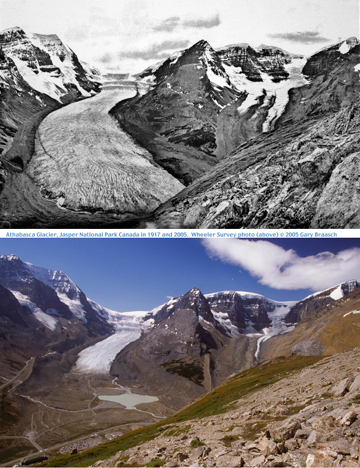
These days, Mr. Breashears is still climbing the Himalayas, but he is lugging more than pitons and ice axes. He’s also carrying special cameras to document stunning declines in glaciers on the roof of the world.

Mr. Breashears first reached the top of Everest in 1983, and in many subsequent trips to the region he noticed the topography changing, the glaciers shrinking. So he dug out archive photos from early Himalayan expeditions, and then journeyed across ridges and crevasses to photograph from the exact same spots.

The pairs of matched photographs, old and new, are staggering. Time and again, the same glaciers have shrunk drastically in every direction, often losing hundreds of feet in height.

“I was just incredulous,” he told me. “We took measurements with laser rangefinders to measure the loss of height of the glaciers. The drop was often the equivalent of a 35- or 40-story building.”

Mr. Breashears led me through a display of these paired photographs at the Asia Society in New York. One 1921 photo by George Mallory, the famous mountaineer who died near the summit of Everest three years later, shows the Main Rongbuk Glacier. Mr. Breashears located the very spot from which Mallory had snapped that photo and took another — only it is a different scene, because the glacier has lost 330 feet of vertical ice.

Some research in social psychology suggests that our brains are not well adapted to protect ourselves from gradually encroaching harms. We evolved to be wary of saber-toothed tigers and blizzards, but not of climate change — and maybe that’s also why we in the news media tend to cover weather but not climate. The upshot is that we’re horrifyingly nonchalant at the prospect that rising carbon emissions may devastate our favorite planet.

NASA says that the January-through-June period this year was the hottest globally since measurements began in 1880. The Web site ClimateProgress.org, which calls for more action on climate change, suggests that 2010 is likely to be the warmest year on record. Likewise, the Global Snow Lab at Rutgers University says that the months of May and June had the lowest snow cover in the Northern Hemisphere since the lab began satellite observations in 1967.

So signs of danger abound, but like the proverbial slow-boiling frog, we seem unable to rouse ourselves.

(Actually, it seems that frogs will not remain in a beaker that is slowly heated. Snopes.com quotes a distinguished zoologist as saying that frogs become agitated as the temperature slowly rises and struggle to escape, although it does not specify how the zoologist knows this.)

From our own beaker, we’ve watched with glazed eyes as glaciers have retreated worldwide. Glacier National Park now has only about 25 glaciers, compared with around 150 a century ago. In the Himalayas, the shrinkage seems to be accelerating, with Chinese scientific measurements suggesting that some glaciers are now losing up to 26 feet in height per year.

Orville Schell, who runs China programs at the Asia Society, described passing a series of pagodas as he approached the Mingyong Glacier on the Tibetan plateau. The pagodas were viewing platforms, and had to be rebuilt as the glacier retreated: this monumental, almost eternal force of nature seemed mortally wounded.

“A glacier is a giant part of the alpine landscape, something we always saw as immortal,” Mr. Schell said. “But now this glacier is dying before our eyes.”

An Indian glaciologist, Syed Iqbal Hasnain, now at the Stimson Center in Washington, told me that most Himalayan glaciers are in retreat for three reasons. First is the overall warming tied to carbon emissions. Second, rain and snow patterns are changing, so that less new snow is added to replace what melts. Third, pollution from trucks and smoke covers glaciers with carbon soot so that their surfaces become darker and less reflective — causing them to melt more quickly.

The retreat of the glaciers threatens agriculture downstream. A study published last month in Science magazine indicated that glacier melt is essential for the Indus and Brahmaputra rivers, while less important a component of the Ganges, Yellow and Yangtze rivers. The potential disappearance of the glaciers, the report said, is “threatening the food security of an estimated 60 million people” in the Indus and Brahmaputra basins.

We Americans have been galvanized by the oil spill on our gulf coast, because we see tar balls and dead sea birds as visceral reminders of our hubris in deep sea drilling. The melting glaciers should be a similar warning of our hubris — and of the consequences that the earth will face for centuries unless we address carbon emissions today.

I invite you to comment on this column on my blog, On the Ground. Please also join me on Facebook, watch my YouTube videos videos and follow me on Twitter.

Rabu, 04 Agustus 2010

When Happy Cows Are Not Happy Cows

From author John Robbins at the Huffington Post

This past week, California Governor Arnold Schwarzenegger signed a bill that will essentially prohibit, starting in 2015, any egg from being sold in the state that comes from caged hens. This bill became law 20 months after a majority of California voters approved Proposition 2, making it clear that concern for the living conditions of livestock is no longer the province of animal rights activists alone.

Recognizing how widespread concern about the humane treatment of farm animals has become, the California Milk Advisory Board has recently ramped up its 10-year "Happy Cow" advertising campaign with a new series of ads proclaiming that "Great milk comes from Happy Cows. Happy Cows come from California." These ads are now being shown across the nation.

Unfortunately, there are a few problems with the ads. For one, they weren't filmed in California at all. They were filmed in Auckland, New Zealand.

And that's just the tip of the iceberg.

Current Milk Board ads claim that 99 percent of the state's dairy farms are family owned. But in order to arrive at this figure, they count as "dairy farms" rural households with one or two cows. Meanwhile, there are corporate-owned dairies in the San Joaquin Valley which have 15,000 or 20,000 cows. It is these far larger enterprises that produce the vast majority of California's milk.

My concern, let me emphasize, is not with small-scale family farms. I have no problem with the many hard-working families who treat their cows well, take care of the land and try to bring a healthy product to market. My problem is with the much larger agribusiness enterprises, the factory farms to whom the animals in their care are nothing but sources of revenue.

Thanks to the practices they employ, the amount of milk produced yearly by the average California cow is nearly 3,000 pounds more than the national average. This increased production may seem like a good thing, but it is achieved at great cost to the animals. The cows are routinely confined in extremely unnatural conditions, injected with hormones, fed antibiotics, and in general treated with all the compassion of four legged milk pumps. Roughly one third of California's cows suffer from painful udder infections, and more than half suffer from other infections and illnesses.

Although genetically engineered bovine growth hormone is banned in many countries including Canada, Australia, New Zealand and much of the European Union, it is widely used in California's largest dairy operations to increase milk production. Unfortunately, it also increases udder infections and lameness in the cows, markedly raises the amount of pus found in milk, and may increase the risk of cancer in consumers.

The natural lifespan of a dairy cow is about 25 years, but one-fourth of California's dairy cows are slaughtered each year (typically at four or five years old), because they've become crippled from painful foot infections or calcium depletion, or simply because they can no longer produce the unnaturally high amounts of milk required of them.

The Milk Board ads present the California dairy industry as a bucolic enterprise that operates in lush, grassy pastures. Some of the ads employ the slogan "So much grass, so little time." But California's dairy industry is concentrated in the dry and barren Central Valley. Here, the cows are typically kept in overcrowded, dirt feedlots. Some never see a blade of grass in their entire lives.

The ads show calves in meadows talking happily to their mothers. But the calves born to California dairy cows typically spend only 24 hours with their mothers, and some do not even get that much. Here is a video that reveals what actually happens to the calves:


The ads propagate the image that California dairy cows live in natural conditions and the practices of the dairy industry are in harmony with the environment. But the amount of excrement produced each year by the dairy cows in the 50-square mile area of California's Chino Basin would make a pile with the dimensions of a football field and as tall as the Empire State Building. When it rains heavily, dairy manure in the Chino Basin is washed straight into the Santa Ana River and some makes its way into the aquifer that supplies half of Orange County's drinking water.

The large-scale factory dairies in California's Central Valley produce more excrement than the entire human population of Texas. About 20 million Californians (65 percent of the state's population) rely on drinking water that is threatened by contamination from nitrates and other poisons stemming from dairy manure. Nitrates have been linked to cancer and birth defects.

The Milk Board defends the ads by saying they are entertaining, and are not intended to be taken seriously. But the Milk Board is not in the entertainment business. It has not spent hundreds of millions of dollars on this ad campaign to amuse the public, but to increase the sales of California dairy products. Besides, does misleading the public become legitimate just because it is done in an entertaining way?

The Milk Board knows that showing calves being taken away from their bellowing mothers and confined in tiny veal crates won't sell their product. Neither will showing emaciated, lame animals who have collapsed from a lifetime of hardship and over-milking, being taken to slaughterhouses and having their throats slit. But this is the reality for animals in the large-scale factory farms that produce most of the state's milk. Covering up this misery with fantasy ads of happy cows who are actually in New Zealand is not amusing. It is perpetrating a sham on the public.

This is why I have joined with People for the Ethical Treatment of Animals (PETA) in a lawsuit that challenges the Milk Board's ads as unlawfully deceptive. Thus far, the Milk Board has prevailed in court, even though it's obvious that the ads lie to the public. Why? Because the California Milk Advisory Board is the marketing arm of the California Department of Agriculture, a government agency. And in California, in a truly Orwellian twist, government agencies are exempt from laws prohibiting false advertising.

Should we hold our advertisers, even if they are government agencies, accountable to reality? Should we require that what they tell us have some resemblance to the truth?

This month, PETA has erected billboards throughout the state that read, "California Cheese Comes From Miserable Cows." PETA, of course, is an animal rights group, but this issue is increasingly being recognized as one that concerns not only vegetarians and animal advocates. Consumers who want the animal products they buy to be from humanely raised animals can be found in every segment of society.

Consideration for the plight of animals is a central part of the American character. It is an essential part of who we are as a people. The "happy cow" ads are an insult to the legitimate humanitarian concerns of millions of people. As consumers, do we want to reward this sort of behavior with our hard-earned dollars?

Abraham Lincoln was speaking not only for vegetarians or for animal rights advocates when he said, "I care not much for a man's religion whose dog or cat are not the better for it."


To learn about steps you can take towards greater physical health, social conscience, and economic freedom, read my latest book The New Good Life: Living Better Than Ever in an Age of Less. For information about my work, and to sign up for my email-list, visit JohnRobbins.info.

Senin, 02 Agustus 2010

After Elevated Park's Success, Other Cities Look Up


By KATE TAYLOR
Published: July 14, 2010 in the New York Times

Detroit is thinking big about an abandoned train station. Jersey City and Philadelphia have defunct railroad beds, and Chicago has old train tracks that don’t look like much now, but maybe they too...

The High Line’s success as an elevated park, its improbable evolution from old trestle into glittering urban amenity, has motivated a whole host of public officials and city planners to consider or revisit efforts to convert relics from their own industrial pasts into potential economic engines.

In many of these places there had already been some talk and visions of what might be, but now New York’s accomplishment is providing ammunition for boosters while giving skeptics much-needed evidence of the potential for success. The High Line has become, like bagels and CompStat, another kind of New York export.

“There’s a nice healthy competition between big American cities,” said Ben Helphand, who is pushing to create a park on a defunct rail line in Chicago. “That this has been done in New York puts the onus on us to do it ourselves and to give it a Chicago stamp.”

The High Line, an elevated freight spur that runs along the West Side of Manhattan and overlooks the Hudson River, was also nothing more than a crumbling eyesore 10 years ago. But since it opened as a park last year, its plantings and vistas, tasteful design and intricate weave through the redbrick bastions of New York’s meatpacking past and contemporary buildings by Frank Gehry and Jean Nouvel have been a hit. Though the High Line is not fully completed — plans have it potentially extending as far north as West 34th Street — more than two million people have already visited.

Developers from Rotterdam and Hong Kong have come looking for ideas. Officials from Jerusalem are hoping to visit. Recently a team from Singapore (Is there really anything old and rusty in Singapore?) spent time on the landscaped walkways that stretch from Gansevoort Street to West 20th Street.

“We could have a full-time job if we wanted to just do tours,” said Lisa Tziona Switkin of James Corner Field Operations, the lead designer on the project. She has walked the park with people from Memphis, Atlanta, Chicago and elsewhere. Many of these visitors are interested in the potential for using outmoded infrastructure to add green space and transportation options as well as to promote cultural and commercial revitalization. Part of the fascination with the High Line, which is operated by the city and the nonprofit Friends group, is that it is more than just a pretty place. The neighborhoods it runs through — the meatpacking district and Chelsea — were already glamorous with many restaurants, bars and art galleries. But the opening of the High Line has made those areas even more of a destination and encouraged the Whitney Museum of American Art to build a museum there.

In the early days the founders of the Friends of the High Line, Joshua David and Robert Hammond, drew their own inspiration from the development of the Promenade Plantée in Paris, an elevated park built beginning in 1988 on an abandoned railroad viaduct.

Now their success is encouraging others. In Philadelphia the idea is to turn the Reading Viaduct, which is 60 feet wide, into an elevated park and bike path.

“Our viaduct is much wider, which gives us more opportunity in some way,” said Paul R. Levy, the president of a business improvement group that is exploring the plan there.

The proposal is the brainchild of John Struble, a furniture maker, and Sarah McEneaney, an artist, who live near the viaduct and who met Mr. David in 2003 when he walked the span with them.

“He totally inspired us,” Ms. McEneaney said. “We got a lot of advice early on.” Still, she said, the project had little momentum until the High Line opened. “That sparked a lot more interest from the city administration,” she said.

Now the business-improvement quarter, known as the Center City District, is conducting a feasibility study focused in part on whether building the park would bring new development to the neighborhood, where many buildings are vacant.

“I was a nonbeliever until I actually walked on the High Line,” Mr. Levy said. “It was a complete turnaround for me.”

Alan Greenberger, the deputy mayor for economic development in Philadelphia, expressed caution about whether what was done in New York could be reproduced elsewhere. “People do look at the economic success and say that’s inspiring,” he said. “Can you replicate it? That’s another story.”

In Chicago, Mr. Helphand is president of Friends of the Bloomingdale Trail, a group modeled after the organization that Mr. Hammond and Mr. David direct. He acknowledged that Chicago does not have the army of private philanthropists that New York does, but said there was still lots of enthusiasm.

“We don’t have Diane von Furstenberg,” he said, referring to a prominent supporter of the High Line, “though we do have a celebrity chef.” (The first two sections of the High Line cost $152 million, $44 million of which was raised by Friends of the High Line.)

Recently, Chicago commissioned a design master plan from a team that includes a firm that was a runner-up in the competition to design the High Line.

Not everyone in Chicago, or other cities for that matter, embraces the notion that all good ideas start in New York. Janet Attarian, a project director for the Chicago Transportation Department, said that the plan for the Bloomingdale Trail has been around since the late 1990s. “It is something that we have been cogitating for a while,” she said.

The Bloomingdale Trail is almost three miles long, twice the length of the High Line, and is wide enough to accommodate bike traffic, which will give it a certain functionality that the High Line lacks.

“In the mornings there will be a rush hour of bicycles,” Mr. Helphand predicted. “It’s the east-west nonmotorized transportation route that we don’t have.”

Jersey City officials, who can practically see the High Line across the Hudson River, want to turn a downtown railroad embankment into an elevated park and transportation corridor. The effort is complicated by a legal battle with a developer that is now in mediation. The City Council on Wednesday voted to raise funds to acquire the embankment should the city win the fight.

Maureen Crowley, a coordinator for the Embankment Preservation Coalition, said that Mr. David and Mr. Hammond have advised the group, and that Mr. Hammond recently joined its advisory board.

The coalition organized a tour of the High Line last year for Mayor Jerramiah T. Healy and several other Jersey City officials, who were impressed, Ms. Crowley said.

Other recent participants in a High Line tour were from Paris, a group of officials from La Défense, that city’s business district. They sought ideas for shaping development in their own neighborhood. The group’s leader, Philippe Chaix, had been involved in developing the Promenade Plantée, the High Line’s muse a decade ago.

“When we were beginning to take the High Line around,” Mr. David recalled, “being able to point to the Promenade Plantée was huge to us. It’s exciting that the High Line can act in the same way — be something that other projects can point to and say, ‘This may sound unusual, but look, they’ve done it here, and look how successful it is.’ ”

A version of this article appeared in print on July 15, 2010, on page A1 of the New York edition.

Sabtu, 31 Juli 2010

Project's Fate May Predict The Future of Mining


BLAIR, W.Va. — Federal officials are considering whether to veto mountaintop mining above a little Appalachian valley called Pigeonroost Hollow, a step that could be a turning point for one of the country’s most contentious environmental disputes.
Todd Heisler/The New York Times

Above is an existing mining operation, adjacent to the Spruce 1 site, which is to the upper left of the cleared areas. More Photos »

The New York Times

The population of Blair, near the Spruce 1 site, has dwindled to 60. More Photos »

The Army Corps of Engineers approved a permit in 2007 to blast 400 feet off the hilltops here to expose the rich coal seams, disposing of the debris in the upper reaches of six valleys, including Pigeonroost Hollow.

But the Environmental Protection Agency under the Obama administration, in a break with President George W. Bush’s more coal-friendly approach, has threatened to halt or sharply scale back the project known as Spruce 1. The agency asserts that the project would irrevocably damage streams and wildlife and violate the Clean Water Act.

Because it is one of the largest mountaintop mining projects ever and because it has been hotly disputed for a dozen years, Spruce 1 is seen as a bellwether by conservation groups and the coal industry.

The fate of the project could also have national reverberations, affecting Democratic Party prospects in coal states. While extensive research and public hearings on the plan have been completed, federal officials said that their final decision would not be announced until late this year — perhaps, conveniently, after the midterm elections.

Environmental groups say that approval of the project in anything like its current form would be a betrayal.

“Spruce 1 is a test of whether the E.P.A. is going to follow through with its promises,” said Bill Price, director of environmental justice with the Sierra Club in West Virginia.

“If the administration sticks to its guns,” Mr. Price predicted, “mountaintop removal is going to be severely curtailed.”

Coal companies say politics, not science, is threatening a practice vital to local economies and energy independence. “After years of study, with the company doing everything any agency asked, and three years after a permit was issued, the E.P.A. now wants to stop Spruce 1,” said Bill Raney, president of the West Virginia Coal Association. “It’s political; the only thing that has changed is the administration.”

While the government does not collect statistics on mountaintop mining, data suggest that it may account for about 10 percent of American coal output, yielding 5 percent of the nation’s electricity. The method plays a bigger economic role in the two states where it is concentrated, Kentucky and West Virginia.

The proposal to strip a large area above the home of 70-year-old Jimmy Weekley, Pigeonroost Hollow’s last remaining inhabitant, was first made in 1997 by Arch Coal, Inc., of St. Louis. The legal ups and downs of Spruce 1 have come to symbolize the broader battle over a method that produces inexpensive coal while drastically altering the landscape.

Spruce 1 started as the largest single proposal ever for hilltop mining, in which mountains are carved off to expose coal seams and much of the debris, often leaking toxic substances, is placed in adjacent valleys.

After years of negotiations and a scaling back of the mining area to 2,278 acres, from its original 3,113 acres, the Spruce 1 permit was approved by the Army Corps of Engineers in 2007 and limited construction began. But this spring, the E.P.A. proposed halting the project.

The announcement caused an uproar in West Virginia. The E.P.A. held an emotional public hearing in May and stopped accepting written comments in June. Arch Coal has objected publicly, but did not respond to requests to comment for this article.

The Obama administration’s E.P.A. has already riled the coal companies by tightening procedures for issuing new mining permits and imposing stronger stream protections. But environmental groups were worried in June, when the agency approved a curtailed mountaintop plan in another site in Logan County, W.Va. Now, as negotiations between the E.P.A. and Arch Coal continue, the Spruce 1 battle is being closely watched as a sign of mountaintop mining’s future.

Feelings run high in the counties right around the project area.

“Spruce 1 is extremely important to all of southern West Virginia because if this permit is pulled back, every mine site is going to be vulnerable to having its permits pulled,” said James Milan, manager of Walker Machinery in Logan, which sells gargantuan Caterpillar equipment.

The loss of jobs, Mr. Milan said, would have devastating effects on struggling communities.

Maria Gunnoe, an organizer for the Ohio Valley Environmental Coalition and a director of SouthWings, which organizes flights to document environmental damages, said that if Spruce 1 went forward, “it’s going to mean the permanent erasure of part of our land and our legacy.”

“We can’t keep blowing up mountains to keep the lights on,” said Ms. Gunnoe, a resident of nearby Boone County who has received death threats and travels with a 9 millimeter pistol.

Mr. Weekley, whose house is in sight of the project boundary, remembers the day in 1997 when he decided to fight it. Nearby mining under previous permits had filled his wooded valley with dust and noise.

“You couldn’t see out of this hollow,” he recalled. “I said, Something’s got to be done or we’re not going to have a community left.”

He and his late wife became plaintiffs in a 1998 suit claiming that the project violated environmental laws. A ruling in their favor was overturned, setting off litigation that continues.

Mr. Weekley said that he had rejected offers of close to $2 million for his eight acres and that he had seen the population of the nearby town of Blair dwindle to 60 from 600, with most residents bought out by Arch Coal.

A rail-thin man who enjoys sitting on his porch with a dog on his lap, Mr. Weekley uttered an expletive when told that coal industry representatives, including Mr. Raney in an interview, referred to the upper tributaries filled in by mining as “ditches” that can be rebuilt. In fact, some of the streams to be filled by Spruce 1 are intermittent, while others, including Pigeonroost Creek, flow year-round.

“I caught fish in that stream as a child, using a safety pin for a hook,” Mr. Weekley said. “If they get that permit, there won’t be a stream here.”

In documents issued in March, the E.P.A. said the project as approved would still smother seven miles of streambed.

Filling in headwaters damages the web of life downstream, from aquatic insects to salamanders to fish, and temporary channels and rebuilt streams are no substitute, the agency said. The pulverized rock can release toxic levels of selenium and other pollutants, it noted.

The effects of Spruce 1 would be added to those of 34 other past and present projects that together account for more than one-third of the area of the Spruce Fork watershed, the agency said.

The debate over Spruce 1 and other mountaintop mine permits has been a source of division and anguish among local residents.

Michael Fox, 39, of Gilbert, is a mine worker who like many other miners here thinks the objections are overblown. “I have three kids I want to send to college,” Mr. Fox said.

One former mountaintop miner who says he now regrets his involvement is Charles Bella, 60. He is one of the remaining residents on Blair’s main street, along the Spruce Fork, which is fed in turn by Pigeonroost Creek.

“I know it put bread on my table, but I hate destroying the mountains like that,” Mr. Bella said.

Kamis, 29 Juli 2010

A Humane Egg

Published: July 11, 201o in the Editorial section of the New York Times

The life of animals raised in confinement on industrial farms is slowly improving, thanks to pressure from consumers, animal rights advocates, farmers and legislators. In late June, a compromise was reached in Ohio that will gradually put an end to the tiny pens used for raising veal calves and holding pregnant sows, spaces so small the animals can barely move.

In California last week, Gov. Arnold Schwarzenegger signed a law requiring that all whole eggs sold in the state conform to the provisions of Proposition 2, the humane farming law that was embraced by state voters in a landslide in 2008. By 2015, every whole egg sold in the state must come from a hen that is able to stretch her wings, standing or lying, without touching another bird or the edges of her cage. This requirement would at least relieve the worst of the production horrors that are common in the industry now.

Since California does not produce all the eggs it eats, this new law will have a wider effect on the industry; every producer who hopes to sell eggs in the state must meet its regulations.

Heartening as these developments are, there is also strong resistance from the food industry and from fake consumer-advocacy groups that are shilling for it.

In fact, there is no justification, economic or otherwise, for the abusive practice of confining animals in spaces barely larger than the volume of their bodies. Animals with more space are healthier, and they are no less productive.

Industrial confinement is cruel and senseless and will turn out to be, we hope, a relatively short-lived anomaly in modern farming.

Selasa, 27 Juli 2010

Organic Food, Health, And The Burden of Proof


Paradoxically, my long-standing interest in organic food has encompassed both ardent support and concerned opposition.

My support for organic food -- and my own family's frequent selection of it -- has largely been based on potential benefits to the planet. These, I think are self evident, so I won't elaborate them here. My concern has been based on the misinterpretations of what organic means.

Organic does not mean "nutritious." Broccoli may be grown conventionally, but still has the nutritional profile of broccoli. Gummy bears -- and sugar, for that matter -- may be organic, which says something good about what they don't contain (pesticide residues). However, it says nothing good about what they do contain, or add to your diet.

Considerable mischief has come from supply-side misrepresentations of organic. Tapping into the burgeoning public interest in "going green," the food industry has draped products in labels touting organic ingredients even when such ingredients are a nominal part of the whole.

According to the USDA, any food sporting "organic" on its label must be "produced by farmers who emphasize the use of renewable resources and the conservation of soil and water to enhance environmental quality for future generations."

Further, "organic meat, poultry, eggs and dairy products come from animals that are given no antibiotics or growth hormones. Organic food is produced without using most conventional pesticides, fertilizers made with synthetic ingredients or sewage sludge [a comfort, to be sure], bioengineering or ionizing radiation."

There is, of course, the fine print. A label that says "organic" is noteworthy for not saying "100 percent organic." Ninety-five percent of the ingredients in such a product must be organic, but the rest can be ... whatever. In products "made with organic ingredients" up to 30 percent of the content need not be. We may get the truth on a food label, but rarely the whole truth.

The industry has done much to propagate the view that organic and nutritious are synonymous. The prevailing view, for example, seems to be that Whole Foods sells only nutritious foods, when, in fact, its commitment to selling "natural and organic" products guarantees no such thing. Standard offerings include, for instance, whipped cream and pepperoni pizza. In any other supermarket, shoppers would recognize these as dubious choices for health promotion -- but under the halo effect of "natural and organic," Whole Foods shoppers may feel they can't go wrong nutritionally. I beg to differ.

When developing the Overall Nutritional Quality Index that now powers the NuVal nutrition guidance system (www.nuval.com), an international team of leading nutrition and public health experts and I wrestled with this dilemma. While we unanimously supported organic food philosophically, we were forced to conclude in 2007 that there simply wasn't sufficient science to include organic in an evidence-based measure of nutritional quality. Work on updating the NuVal algorithm will begin with the release of the 2010 Dietary Guidelines for Americans, and we will once again need to address this issue.

Ironically, both sides of the organic/health debate have received a boost from recent research. A study just published in Pediatrics found higher levels of pesticide metabolites in the urine of children with attention deficit disorder. The association between organochlorine pesticides, which affect the nervous system, and ADD makes sense, and was clear in this new study despite a good attempt to control for other factors. Pesticides residues may or may not "cause" ADD, but they are at least implicated by association. Other research over recent years suggests that organic produce may be, on average, 20 percent more concentrated in vitamins and minerals than conventionally grown produce.

On the other hand, a systematic review of the literature on organic foods published May 12 in the American Journal of Clinical Nutrition concluded that "evidence is lacking for nutrition-related health effects."

This paper, however, bespeaks absence of evidence, not evidence of absence. Consider what it would take to PROVE that organic foods confer a health benefit.

Imagine a clinical trial in which 1,000 people are assigned to strictly organic foods, and another 1,000 to conventionally grown foods, for 10 years. Such a trial would be enormously costly, cumbersome and logistically demanding -- if feasible at all. Some chemical contaminants would almost certainly get into the diets of the 'organic' group despite the very best efforts to prevent it, and these would also contaminate the study- because they would narrow the intended difference between treatment groups.

Nonetheless, imagine there were three fewer cases of cancer, and/or of ADHD, and/or perhaps several other maladies, in the organic group. Just "three fewer cases" over 10 years would be too few to distinguish from a statistical fluke in a sample of a thousand people. And, realistically, there might be even less than three fewer cases of cancer, because many cancers develop over a period of more than 10 years; a 10 year study might just not be long enough.

But let's imagine there were, indeed, three fewer cases of cancer, three fewer cases of ADHD, three fewer neurological ailments, and so on, in the organic group over a 10 year period. While none of this would likely be statistically distinguishable from random variation, consider what it would mean to the public health. Three extra cases of cancer per ten years in 1,000 people caused by pesticide residues would mean 3,000 extra cancers every ten years per million people! In a population of 300 million, it means 300,000 extra cancers every decade!

What this tells us is that the health effects of pesticide residues and other common contaminants of conventionally produced food could be truly enormous at the population level, and still all but invisible to epidemiologic research.

Organic and nutritious do not, and never will, mean the same thing -- please be aware of that, and beware marketing messages to the contrary. But along with known benefits of organic food for the planet, we have more and more hints of potential health benefits as well. The case gets incrementally stronger with time that a food that is nutritious to begin with is better still if organic.

While we don't have, and are unlikely to get, definitive proof of the health benefits of eating organic, perhaps it's time for the burden of proof to go the other way: since organic food is better for the planet and is likely to be better for health, we should accept it as such ... unless someone can prove it isn't!

-fin

Dr. David L. Katz; www.davidkatzmd.com

Follow David Katz, M.D. on Twitter: www.twitter.com/DrDavidKatz